
If you are running or auditing a business in Nepal, navigating the financial reporting landscape can be hectic, especially with changing definitions, carve-outs, and implementation dates. With the Nepal Financial Reporting Standard for Small and Medium-sized Entities (NFRS for SMEs) now mandatory, understanding exactly where your entity stands is important for ensuring compliance with the standards.
What is an SME under NFRS?
According to the Accounting Standards Board (ASB) and the Institute of Chartered Accountants of Nepal (ICAN), an entity must adopt NFRS for SMEs if it meets two fundamental conditions:
-
It does NOT have public accountability.
-
It publishes general-purpose financial statements for external users (such as shareholders, tax authorities, and financial institutions).
In practice, a business falls into the ‘SME’ bracket if it sits comfortably between two layers: it is too small to require Full NFRS, but too large to qualify for the NAS for MEs (Nepal Accounting Standards for Micro Entities).
The Upper Limit: Full NFRS
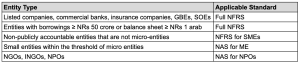
Your business is not an SME and must use Full NFRS if it has public accountability or meets the criteria for ‘Economic Significance.’ You cross into Full NFRS territory if your entity is:
-
A listed company (or in the process of issuing public debt/equity).
-
A bank, financial institution, insurance company, or cooperative operating a fiduciary business as its primary activity.
-
A Government Business Enterprise (GBE). (Learn what a GBE is here)
-
An entity of Economic Significance (meeting at least one of the following criteria for two consecutive years):
-
Total Borrowings: NPR 50 Crore or more.
-
Annual Turnover: NPR 100 Crore or more.
-
Gross Balance Sheet Total: NPR 100 Crore or more.
-
Employee Count: More than 300 average employees.
-
The Lower Limit: NAS for Micro-Entity
On the flip side, very small businesses are exempted from NFRS for SMEs and can use the much simpler NAS for Micro-Entities. To qualify as a micro-entity, a business must stay below these specific financial thresholds:
-
Annual Turnover: Up to 20 Crore or less.
-
Total Borrowings: Up to 10 Crore or less.
-
Gross Balance Sheet Total: Up to 20 Crore or less.
Rule of Thumb: If your private business does not hold public funds, has a turnover below NPR 100 Crore, but clears more than the Micro-Entity baseline, you are legally required to implement NFRS for SMEs.
Financial Reporting Tiers in Nepal
For model financial statements under NFRS for SME as per ICAN click here.