
Foundation & Introduction
At its core, preparing IFRS 18 financial statements requires adhering to a newly established two-role framework that clearly separates the purpose of the primary financial statements versus the notes:
- Primary Financial Statements: Must provide useful, structured summaries of an entity’s assets, liabilities, equity, income, expenses, and cash flows to provide an understandable overview and enable comparability.
- The Notes: Must provide material, disaggregated information necessary to fully understand the line items presented in the primary statements and to supplement them with additional details.
IFRS 18 changes the presentation of financial performance but builds on existing principles. Concepts such as going concern, accruals, offsetting, and reporting frequency, which were in IAS 1, are moving to IAS 8.
This transition is part of the IASB’s effort to streamline the IFRS framework: IFRS 18 will now focus strictly on the presentation and structure of the financial statements, while the newly expanded IAS 8 (retitled as Basis of Preparation of Financial Statements) serves as the manual for the underlying principles of how those statements are prepared.
For preparers of financial statements, this means that while the core rules haven’t changed, they will now look to a different standard as the base for these essential reporting requirements.
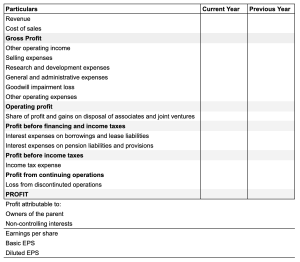
The Redesigned Statement of Profit or Loss
IFRS 18 establishes five mandatory classification categories for all income and expenses. They are:
- Operating
- Investing
- Financing
- Income Taxes
- Discontinued Operations
Once you’ve understood the basic structure of the income statement under IFRS 18, you’ll need to know that the new standard introduces three essential subtotals that serve as reliable benchmarks for everyone.
- Operating profit or loss
- Profit or loss before financing and income taxes
- Profit or loss
Treatment of Foreign Exchange and Derivatives:
- Foreign Exchange (FX): FX differences must be classified in the exact same category as the underlying income or expense that generated them. However, if tracking this involves undue cost or effort, the standard permits classifying the FX differences directly into the operating category.
- Derivatives: Gains and losses on derivatives in a qualifying hedge are aligned with the hedged risk category. For derivatives used for risk management that are not designated, they follow the hedged risk unless grossing up is needed, in which case they are accounted for as operating.
Classification of Operating Expenses
Three Classification Methods of Operating Expenses
- By Nature: Expenses are grouped by the type of economic resource consumed to carry out the entity’s activities, without reference to the specific business activity or department for which they were used. Common examples include raw materials, transport costs, employee benefits, and depreciation.
- By Function: Expenses are allocated and aggregated according to the specific business activity or role to which the consumed resource relates. Typical examples include the cost of goods sold, research and development (R&D) expenses, sales and marketing expenses, and administrative expenses. Interestingly, IFRS 18 does not formally define ‘function’; instead, entities must establish their own definitions based on their activities and apply them consistently.
- Mixed Basis: IFRS 18 explicitly permits entities to present some expenses by function and others by nature simultaneously on the face of the income statement. If a mixed basis is used, the line item descriptions must clearly identify what is included or excluded, for example, by labelling a line item ’employee benefits other than those included in cost of sales’ to avoid confusing users.
Selecting the Most Useful Structured Summary
- Main components or drivers of profitability: What information is most relevant to the entity’s margins? For a retail entity, ‘cost of sales (a function) might be the main driver, whereas for a service provider, ’employee costs’ (a nature) might be significantly more relevant.
- Internal management reporting: The classification should closely align with how the business is managed and how management reviews performance internally.
- Industry practice: Aligning with peers who use similar methods improves comparability for users of financial statements.
- Arbitrariness of allocation: If allocating specific expenses to functional line items requires highly arbitrary splits, those expenses should instead be classified by nature.
Strict Mandates When Using ‘By Function’ or ‘Mixed’ Approaches
|
The Five Mandatory Nature Disclosures
|
|---|
|
1. Depreciation (property, plant & equipment, investment property, and right-of-use assets)
|
|
2. Amortisation of intangible assets
|
|
3. Employee benefits (including share-based payments)
|
|
4. Impairment losses and reversals
|
|
5. Inventory write-downs and reversals
|
Classification Requirements for Specific Entities
- Banks and Lending Institutions: Entities that provide financing to customers must classify interest income from loans, as well as the interest expenses related to funding those loans, directly in the operating category rather than in investing or financing.
- Insurers: Because insurers invest heavily in assets as a core business function, income and expenses from investment properties, as well as net gains on associates and joint ventures measured at fair value, must be reclassified from the investing category to the operating category.
- Investment Firms: Investment entities that don’t consolidate certain subsidiaries but measure them at fair value through profit or loss must record those fair value gains or losses in operating profit, not investing. Note: Equity-accounted investments are always in the investing category, regardless of the entity’s main business.
Dual Activity and Multi-Segment Entities
Under IFRS 18, evaluating dual-activity and multi-segment entities depends on accurately identifying all of an entity’s ‘main business activities’ to drive the correct classification of income and expenses.
Since an entity can operate across multiple sectors, management often relies on internal performance measures or IFRS 8 reportable segments to evidence its main activities. For groups, this assessment must be performed from the consolidated perspective, meaning a subsidiary’s standalone main activities might not align with the group’s overall activities, thereby triggering consolidation reclassification adjustments. Operationally, these entities must apply general classification rules to their standard business lines while layering on strict, specific requirements for any “specified” main activities (such as investing in assets or financing customers).
If a dual-activity entity operates as both a customer financier and a financial asset investor (such as a combined retail and investment bank), it is stripped of the standard accounting policy choice for cash and cash equivalents and must strictly classify all related income and expenses within the operating category.
Aggregation and Disaggregation
IAS 7 Statement of Cash Flows Update
To harmonise the primary statements, IFRS 18 amends IAS 7. Entities utilising the indirect method for the statement of cash flows must now universally use IFRS 18’s operating profit as the uniform starting point for preparing cash flows, rather than having the flexibility to start with net profit or profit before tax.
- Entities Without Specified Main Business Activities: Interest and dividends received must now be strictly classified as investing cash flows, while interest and dividends paid must be classified as financing cash flows.
- Entities With Specified Main Business Activities (e.g., Banks): These entities must classify interest paid, interest received, and dividends received into a single category (typically operating) that directly mirrors how the related income and expenses are classified in the newly redesigned income statement. Dividends paid continue to be classified as financing cash flows.
Management-Defined Performance Measures (MPMs)
Definition and Scope of MPMs
- External Communication: It is used in public communications outside the IFRS 18 financial statements (e.g., management commentary, earnings releases, or investor presentations).
- Management’s View: It communicates management’s view of an aspect of the entity’s overall financial performance.
- Not IFRS-Defined: It is not a subtotal explicitly required by IFRS Accounting Standards, nor is it a common subtotal explicitly listed in the standard (such as gross profit, or IFRS 18 operating profit before depreciation, amortisation, and impairments).
- Financial ratios (like return on equity, combined ratios, or cost-to-income ratios).
- Cash flow or liquidity measures (like free cash flow).
- Single-element subtotals comprising only income or only expenses (like ‘adjusted revenue’).
- Non-financial performance measures (like customer satisfaction scores or carbon emissions).
Now, for understanding, let’s look at some examples that could be MPM as per IFRS 18:
- Adjusted Operating Profit: Operating profit modified to exclude a major restructuring cost.
- Adjusted EBITDA: Earnings before interest, tax, depreciation, and amortisation, further adjusted for non-recurring legal settlements.
- Adjusted Profit or Loss: Net income excluding unique items, such as an impairment of a non-current asset.
Notes and Disclosure Requirements for MPMs
- A clear statement that MPMs reflect management’s view and are not necessarily comparable to measures with similar labels used by peers
- A description of why the MPM provides useful information and precisely how it is calculated.
- The specific line item in the primary income statement to which the amount relates.
- The income tax effect for that specific adjustment.
- The effect on non-controlling interests (NCI) for that specific adjustment.
Consistency and Changes in MPMs
- Changes how it calculates an existing MPM,
- Introduces a completely new MPM, or
- Stops using a previously disclosed MPM
If any of the above three things are done by the company, then it must provide a detailed explanation of the reasons for the change, addition, or cessation. Most importantly, the entity must provide restated comparative information for prior periods to reflect this change, unless management can prove it is genuinely impracticable to do so.
Effective Date and Transition
- Applicability of NFRS: Click Here
- NAS for NPOs: Click Here
- Leases (IFRS 16): Click Here