
NAS for NPOs Nepal is now mandatory, yet most NGOs and INGOs operating in the country still have no clear picture of what it actually requires, who it applies to, and what their finance team needs to do about it. This guide is that explanation. Written in plain English, based directly on the Nepal Accounting Standard for Not-for-Profit Organisations 2018 issued by the Accounting Standards Board (ASB) Nepal.
What Is NAS for NPOs Nepal?
NAS for NPOs is a mandatory accounting standard developed by the Accounting Standards Board (ASB) Nepal in 2018. It sets out the rules for how non-profit organisations in Nepal must prepare and present their financial statements.
Before this standard existed, NPOs in Nepal used a patchwork of accounting practices. Some organisations followed cash-based accounting. Others used their own formats shaped by whatever their donor happened to require. There was no consistent, comparable picture of how Nepal’s non-profit sector was actually functioning financially.
NAS for NPOs Nepal changes that. It brings NGOs and INGOs under a single, structured reporting framework that is consistent with international best practice. It is built on accrual accounting, double-entry bookkeeping, and standardised financial statement formats.
The standard was issued by ASB Nepal in 2018 and pronounced by ICAN for mandatory implementation in phases, with INGOs required to comply from 16 July 2023, and all other NGOs and NPOs from 16 July 2024.
Who Does NAS for NPOs Nepal Apply To?
The standard applies to non-profit organisations as a single reporting entity. The standard’s own language is broad and deliberate: it applies ‘regardless of whether or not legal personality applies to all forms of non-profit organisations for the purpose of the benefit of society as a whole’.
In practice, this means the standard covers:
- INGOs (International Non-Governmental Organisations) operating in Nepal. Mandatory from 16 July 2023 (Nepali FY 2080/81).
- NGOs (Non-Governmental Organisations) registered under the Association Registration Act. Mandatory from 16 July 2024 (Nepali FY 2081/82).
- Other NPOs including trusts, not-for-profit associations, and profit-not-distributing companies operating for the benefit of society.
If your organisation receives donor funding, submits audited accounts to the Social Welfare Council (SWC), or operates under a donor agreement, this standard almost certainly applies to you.
The standard’s purpose is explicit: it exists to report to external donors, members, creditors and other entities that provide resources to non-profit organisations. This is not merely a compliance exercise. It is about giving the people who fund your work a reliable, standardised picture of how that money is being used.
The Biggest Change: Cash Accounting Is Out
If there is one thing your finance team needs to understand first, it is this.
Under NAS for NPOs Nepal, cash-based accounting is no longer acceptable. The standard is built on two non-negotiable foundations:
Accrual accounting: Transactions are recorded when they occur, not when cash moves. If your organisation incurred an expense in Chaitra but paid it in Shrawan, it is recorded in Chaitra.
Double-entry bookkeeping: Every transaction has two sides. Every debit has a corresponding credit.
This shift from cash to accrual accounting is where most NGOs struggle in the transition. Teams that have been recording income when donor funds arrive in the bank, and expenses when payments are made, need to fundamentally rethink their approach.
The going concern assumption also applies. Your financial statements are prepared on the assumption that your organisation will continue operating for the foreseeable future. If that is not the case and if there is a genuine intention to wind down or significantly curtail operations, that fact must be disclosed.
The Seven Financial Statements Required
A complete set of financial statements under NAS for NPOs Nepal includes seven components. The first five apply to all NPOs. The final two apply specifically to externally funded projects where donor agreements require project-level reporting.
1. Statement of Financial Position
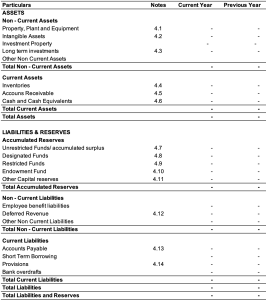
This is the equivalent of a balance sheet. It presents your organisation’s assets, liabilities, and fund balances as at the end of the reporting period. It must separately present restricted, unrestricted, designated, and endowment funds.
2. Statement of Income and Expenditure
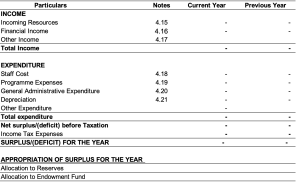
This replaces the traditional income and expenditure statement, but with an important requirement: it must present the integrated result of the entire NPO as a single unit. Where your organisation has unique purpose operations, for example, a specific programme or enterprise, separate columns can be used, but the overall picture must be consolidated.
3. Statement of Change in Reserve
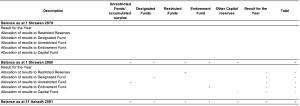
This shows how the organisation’s accumulated funds and reserves have moved during the period. It is the NPO equivalent of a statement of changes in equity.
4. Cash Flow Statement
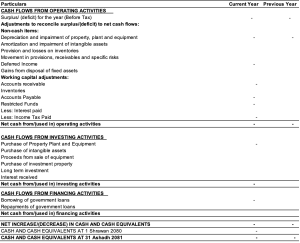
The cash flow statement can be prepared using either the direct method (showing actual cash receipts and payments) or the indirect method (starting from the surplus/deficit and working back to cash). Both are permitted under NAS for NPOs Nepal.
5. Statement of Accounting Policies and Notes to Financial Statements
This is not optional. It is a required component of your financial statements. It includes your significant accounting policies and all explanatory notes required by the standard.
6. Fund Accountability Statement
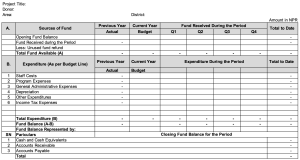
This applies where your organisation manages externally funded projects. It provides a project-level view of income received and expenditure incurred against donor funds, giving donors the accountability picture their agreements typically require.
7. Statement of Budget Variance (Budgeted vs Actual Expenditure Report)
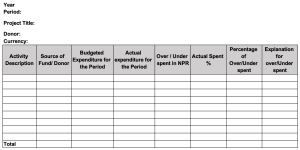
Also project-specific, this statement compares what was budgeted against what was actually spent. Where significant variances exist, these need to be explained.
One important note: the standard allows flexibility in naming. Your organisation may use different titles for these statements, for example, ‘Balance Sheet’ instead of ‘Statement of Financial Position ‘, as long as the content requirements are met.
For the full EXCEL format of NAS for NPOs Nepal as prescribed by ICAN, please click this link.
Fund Accounting: The Core of NPO Reporting
Fund accounting is what makes non-profit financial reporting fundamentally different from other commercial reporting. Under NAS for NPOs Nepal, funds must be clearly classified and presented separately as Unrestricted, Restricted, Endowment, and Accumulated.
Unrestricted Funds
Unrestricted funds are the NPO equivalent of an organisation’s own capital. They are also called General Funds or Accumulated Surplus. These are resources available for the organisation’s general purposes, as set out in its MOA/AOA. The organisation’s board or the leadership can decide how these are used, within the organisation’s stated objectives.
Designated Funds
When the governing body earmarks part of unrestricted funds for a future specific purpose, for example, setting aside funds for building renovation, those amounts are described as designated funds. Crucially, designated funds remain part of the unrestricted fund category. They are an internal designation by management, not an externally imposed restriction.
Restricted Funds
Restricted funds are those that can only be applied for specific purposes, typically imposed by the donor through a grant agreement and can also be self-imposed by the organisation during fundraising campaigns. A restricted fund cannot be redirected for general operational use simply because the organisation needs the money.
Under the standard, income accretions generated from restricted fund assets are subject to the same restriction as the principal fund. If a donor has restricted a grant for a specific health programme, interest earned on those funds sitting in the bank is also typically restricted to the same purpose.
When a project ends, and a surplus of restricted funds remains, those funds may be transferred to the unrestricted fund only if the donor agreement explicitly permits it. If the agreement is silent on the matter, the funds remain restricted until otherwise agreed by mutual agreement of the donor and the entity.
Endowment Funds
An endowment is a specific form of restricted fund held on trust to be retained for the benefit of the organisation as a capital fund. The key distinction is that endowment funds cannot normally be spent as if they were income, so the capital must be preserved. Endowment funds must always be separately identified and presented in the financial statements. They cannot be merged with other fund categories.
Accumulated Fund
The concept of accumulated funds in NPO accounting is similar to retained earnings in commercial entities. The standard defines financial capital maintenance as follows: an NPO’s capital has been maintained if the financial value of its net assets at the end of a period equals or exceeds that at the beginning of the period.
Revenue and Grant Recognition: When to Record Income?
This is where many NPOs make their most significant accounting errors, and where non-compliance with NAS for NPOs Nepal is most commonly identified in audits.
Restricted Contributions (Conditional Grants)
Restricted contributions are received under agreements that impose conditions on how the funds are to be used and what the organisation must deliver. The standard is clear: revenue from restricted contributions should not be recognised until there is reasonable assurance that the contribution will be received and the conditions stipulated for its receipt have been complied with.
The accounting flow works like this in practice:
When you receive a restricted grant, for example, it is credited to your bank account; you do not immediately record it as income. Instead, you recognise it in the restricted fund account on the Statement of Financial Position, with a corresponding entry in the bank account.
Then, at the end of each month (or on a systematic basis), an amount equivalent to the amount spent on agreed restricted activities during that period is transferred to income. You do this by debiting the restricted fund account (reducing the liability/deferred amount) and crediting the restricted income account in the Statement of Income and Expenditure.
This approach means your Income and Expenditure statement reflects what you have actually earned through delivery, not what the donor deposited into your account.
Unrestricted Revenue
Unrestricted revenue is simpler. It should be recognised when the amount can be measured reliably and when it is probable that the economic benefits will flow to the organisation. This follows standard revenue recognition principles consistent with how commercial entities treat unrestricted income.
Government Grants and Subsidies
If there is no restriction on the use of a government grant or subsidy, it is recognised as income on receipt. If the grant comes with conditions, it is recognised as an increase in net assets, not as revenue, until those conditions are met.
In-Kind Donations
In-kind donations (goods, services, or assets donated rather than cash) must be recognised and measured at fair value. This is a requirement that many NGOs overlook entirely. If an organisation receives donated office equipment, second-hand vehicles, or volunteer professional services with a determinable fair value, these need to be reflected in the financial statements.
Disclosure Requirements: What the Notes Must Cover
Notes to the financial statements are not a formality. Under the NAS for NPOs Nepal, the following disclosures are mandatory:
Organisational disclosures:
- Introduction of the organisation and its activities
- Nature of the organisation
- Accounting policies adopted, including recognition criteria for assets, liabilities, income, and expenses
Financial instrument disclosures:
- Contents of cash and cash equivalents
- Highlights of debt that must be repaid in cash
- Collateral received or provided
Fund-specific disclosures:
- Accounting policy adopted for restricted and unrestricted funds, including how they are presented
- Nature and extent of restricted contributions recognised during the period
- Any unfulfilled conditions or contingencies attaching to assistance that has already been recognised
Other material disclosures:
- Contents of in-kind donations received
- Related party relationships and material transactions with them
- Details of any court cases at year-end, including amounts in litigation
- Any other matters that are material to the financial statements
The related party disclosure requirement deserves particular attention. Many NGOs in Nepal have significant transactions with related organisations, sister NGOs, or individuals connected to the governing body. These must be disclosed even when the transactions are conducted at arm’s length.
Do you need an expert to guide you through implementation of NAS for NPOs Nepal? If yes, please click here.
Transition: How to Adopt NAS for NPOs Nepal for the First Time
The standard requires retrospective application. This means you apply it as if you had always been following it by restating your opening balances to reflect what they would have been under NAS for NPOs Nepal.
There is a relief provision for situations where full retrospective application is genuinely impracticable. In those cases, the standard can be applied from the earliest period for which retrospective application is practically achievable. If your organisation uses this relief, the fact must be disclosed. Note that for this relief to work, there must be genuine impracticability, not just inconvenience.
In practical terms, transitioning to NAS for NPOs Nepal typically involves:
Step 1: Gap analysis. Compare your current accounting practices against each requirement of NAS for NPOs Nepal. Identify where you are currently non-compliant.
Step 2: Chart of accounts redesign. Your chart of accounts likely needs to be restructured to properly separate restricted, unrestricted, designated, and endowment funds by project and donor.
Step 3: Opening balance restatement. Restate your opening statement of financial position to reflect NAS for NPOs Nepal classifications. Do this for the earliest period opening balance.
Step 4: Policy documentation. Draft and formally adopt your accounting policies. These must be approved by the governing body and disclosed in your financial statements.
Step 5: Systems and templates. Ensure your accounting system can produce the seven required financial statements and generate the fund accountability and budget variance reports required for donor-funded projects.
Step 6: Auditor engagement. Bring your auditor in early.
What Happens If You Don’t Comply?
The NAS for NPOs Nepal standard itself does not contain specific penalties. The enforcement sits with Nepal’s regulatory authorities rather than the accounting standard. But the practical consequences of non-compliance are significant.
Your external auditor must issue a qualified audit report if your financial statements do not comply with the NAS for NPOs Nepal. A qualified opinion signals to donors, the Social Welfare Council, and other regulators that your financial statements may not present a true and fair view.
From a donor perspective, an unqualified or non-compliant financial statement raises immediate questions about the organisation’s capacity and governance. For organisations that depend on international donors or operate under SWC oversight, this is not a theoretical risk. It can directly affect your ability to receive and renew funding.
For organisations required to submit audited accounts to the Social Welfare Council annually, non-compliant accounts create the risk of registration complications at renewal.
Summary: Key Obligations at a Glance
| Requirement | Detail |
|---|---|
| Accounting basis | Accrual, double-entry |
| Mandatory for INGOs | From 16 July 2023 |
| Mandatory for NGOs/NPOs | From 16 July 2024 |
| Financial statements required | 7 (5 core + 2 project-specific) |
| Restricted fund income | Recognised only when conditions are met |
| In-kind donations | Must be recorded at fair value |
| Transition approach | Retrospective |
| Notes required | Yes. Organisational, fund-specific, related parties, litigation, etc. |
Need Help Implementing NAS for NPOs Nepal?
If your organisation is working through the transition to NAS for NPOs Nepal compliance, whether that means restating your opening balances, restructuring your chart of accounts, training your finance team, or preparing for your first compliant audit, I work directly with NGOs and INGOs in Nepal on exactly these challenges.
Book a consultation to talk through where your organization currently stands and what practical steps are needed.