
The full set of Nepal Financial Reporting Standards (NFRS) is too complex and burdensome for small and medium-sized companies. In response to international demand from both developed and emerging economies, the International Accounting Standards Board (IASB) issued the IFRS for SMEs Accounting Standard, which the Accounting Standard Board Nepal subsequently adopted. The NFRS for SMEs Disclosure Checklist is meant to be a tool for entities, helping them navigate the specific presentation and disclosure requirements necessary to achieve a fair presentation of their financial position, performance, and cash flows.
This comprehensive article explores the core components, underlying principles, and specific reporting requirements that underpin the NFRS for SMEs Disclosure Checklist.
NFRS for SMEs Disclosure Checklist Scope
Before using the NFRS for SMEs Disclosure Checklist, an entity must determine whether it falls within the standard’s scope. The NFRS for SMEs is intended for entities that do not have public accountability but publish general-purpose financial statements for external users, such as owners not involved in management, existing and potential creditors, and credit rating agencies. Read this article that I have written with due care to understand in depth about NFRS for SMEs.
NFRS for SMEs Disclosure Checklist
General Presentation and Compliance Disclosures
The first major checkpoint on the NFRS for SMEs Disclosure Checklist revolves around the overall presentation of the financial statements.
Fair Presentation and Statement of Compliance
Financial statements must present fairly the financial position, financial performance, and cash flows of the entity. An entity whose financial statements comply with the standard must make an explicit and unreserved statement of such compliance in the notes. The standard strictly dictates that financial statements cannot be described as complying with the NFRS for SMEs unless they meet all of its requirements.
Departures from the Standard
In extremely rare circumstances, where management concludes that complying with a specific requirement would be so misleading as to conflict with the objective of financial statements, the entity must depart from that requirement. In such events, the standard requires the entity to detail the nature of the departure, the treatment the standard would have required, the reason the required treatment is misleading, and the new treatment adopted.
Comparative Information
Entities must disclose comparative information in respect of the previous comparable period for all monetary amounts presented in the current financial statements, as well as relevant narrative and descriptive comparative information.
Entity Information
The checklist requires basic identifying disclosures, including the entity’s domicile and legal form, country of incorporation, registered office address, and a description of its principal activities.
Structuring the Notes to the Financial Statements
Section 8 of NFRS for SMEs governs the structure of the disclosures, ensuring that the notes are presented systematically and predictably. The NFRS for SMEs Disclosure Checklist requires the notes to be ordered as follows:
- A statement of compliance with the NFRS for SMEs Accounting Standard.
- A summary of material accounting policy information applied by the entity.
- Supporting information for items presented in the financial statements, following the sequence of the statements and line items.
- Any other required disclosures.
Crucially, the checklist requires disclosure of the specific judgments, apart from those involving estimates, that management has made when applying accounting policies that have the most significant effect on recognized amounts. Furthermore, entities must disclose information about key assumptions concerning the future and other major sources of estimation uncertainty at the reporting date that could result in a material adjustment to the carrying amounts of assets and liabilities in the next financial year.
Specific Item Disclosures NFRS for SMEs Disclosure Checklist
The NFRS for SMEs Disclosure Checklist breaks down specific note requirements section by section. Below is an overview of the most critical areas:
-
Financial Instruments (Sections 11 & 12)
Accounting for financial instruments is notoriously complex under full NFRS, but the SME standard drastically simplifies this by splitting instruments into two categories based on cash flow characteristics: basic financial instruments (Section 11) and other/complex financial instruments (Section 12).
Accounting Treatment for Financial Instruments under NFRS for SMEs
Most basic instruments (such as simple receivables and payables) are initially measured at transaction price and subsequently measured at amortised cost, less impairment. Complex instruments are measured at fair value through profit or loss (FVTPL). The standard completely removes intention-based categories like ‘available for sale’ or ‘held to maturity’. Furthermore, derecognition rules are simpler, removing the complex ‘pass-through’ and ‘continuing involvement’ tests. Hedge accounting is highly restricted, permitted only for four specific risks (e.g., interest rate risk of a debt instrument, foreign exchange risk).
Checklist Requirements for Financial Instruments under NFRS for SMEs
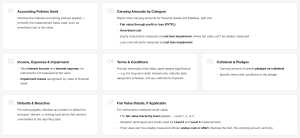
The NFRS for SMEs disclosure checklist omits the vast majority of the burdensome disclosures required by NFRS. Entities simply need to disclose the carrying amounts of financial assets and liabilities broken down by category (amortised cost vs. FVTPL), total interest income and expense, any impairment losses, and the details of any financial assets pledged as collateral.
-
Property, Plant and Equipment (PPE) (Section 17)
Property, Plant, and Equipment represent the tangible, long-term assets used in operations as per NFRS for SMEs.
Accounting Treatment for PPE under NFRS for SMEs
A major relief for SMEs is that the revaluation model is strictly prohibited in all circumstances. All PPE must be measured at cost less accumulated depreciation and accumulated impairment losses. Additionally, management is required to reassess only residual values, useful lives, and depreciation methods when there is a clear indication of change, rather than performing mandatory annual reviews.
Checklist Requirements for PPE under NFRS for SMEs
For PPE, the NFRS for SMEs disclosure checklist requires entities to disclose the measurement bases used for determining the gross carrying amount, the specific depreciation methods and useful lives used, and a reconciliation showing the gross carrying amount and accumulated depreciation at the beginning and end of the period. Importantly, even if the fair value of the PPE is materially different from its carrying amount, the checklist does not require fair value disclosure.
-
Investment Property (Section 16)
Investment properties are real estate assets held specifically to earn rental income or to appreciate in value rather than for use in normal operations.
Accounting Treatment
Full NFRS allows entities to choose freely between the cost model and the fair value model. NFRS for SMEs, however, is circumstance-driven. If an SME can measure the fair value of the investment property reliably without undue cost or effort, it must use the fair value model, with changes in fair value recognized in profit or loss. If fair value cannot be determined without undue cost or effort, the entity must use the cost model and account for the property as PPE.
Checklist Requirements
If the entity is required to use the cost model because fair value is difficult to obtain, the NFRS for SMEs disclosure checklist does not require the entity to disclose fair value at all. The entity must simply provide a description of the property, an explanation of why fair value cannot be reliably determined, and, if possible, a highly likely range of estimates.
-
Intangible Assets and Goodwill (Sections 18 & 19)
Intangible assets are identifiable non-monetary assets without physical substance, while goodwill arises during business combinations when the purchase price exceeds the fair value of identifiable net assets.
Accounting Treatment for Goodwill and Intangible Assets under NFRS for SMEs
The standard provides massive relief regarding Research and Development (R&D). All R&D costs must be recognized as expenses as incurred; the capitalization of development costs is strictly prohibited. Furthermore, for cost-benefit reasons, the standard assumes that all intangible assets and goodwill have finite useful lives and must be amortized. If management cannot reliably estimate the useful life, it is presumed to be 10 years. Impairment testing is required only when there are specific indicators of impairment, thereby removing the need for mandatory annual impairment tests.
Checklist Requirements for Goodwill and Intangible Assets under NFRS for SMEs
The NFRS for SMEs disclosure checklist requires entities to disclose the amortization periods, the carrying amounts of assets, and a reconciliation of the opening and closing balances. Because the standard eliminates indefinite-life intangibles, SMEs are spared from the complex narrative disclosures detailing the assumptions used in discounted cash flow models for annual impairment testing.
-
Inventories (Section 13)
Inventories are assets held for sale in the ordinary course of business, in the process of production, or materials to be consumed in production.
Accounting Treatment
The rules for inventories are essentially identical to full NFRS. Inventories are measured at the lower of cost and selling price less costs to complete and sell. SMEs are permitted to use standard costing, the retail method, or the most recent purchase price if the result approximates cost. The Last-In, First-Out (LIFO) cost formula is strictly prohibited.
Checklist Requirements
The NFRS for SMEs disclosure checklist requires disclosure of the accounting policies adopted (such as FIFO or weighted average), the total carrying amount appropriately classified for the business, the amount of inventory recognized as an expense (cost of goods sold), and any impairment losses recognized or reversed during the period.
-
Investments in Associates and Joint Ventures (Sections 14 & 15)
Associates are entities over which the investor has significant influence, whereas joint ventures are arrangements under joint control.
Accounting Treatment
Unlike full NFRS, which mandates the use of the equity method for these investments, the SME standard provides an alternative. An entity can account for its investments in associates and joint ventures using the cost model, the equity method, or at fair value through profit or loss.
Checklist Requirements
The disclosures for these investments are significantly lighter. The NFRS for SMEs disclosure checklist explicitly omits the requirement to provide summarized financial information (such as total assets, liabilities, revenues, and profit) of the associate or joint venture, which is a rigorous requirement under full NFRS.
-
Leases (Section 20)
Leases are agreements that convey the right to use an asset for a specified period in exchange for consideration.
Accounting Treatment for Leases under NFRS for SMEs
A unique simplification exists for operating leases. Generally, lease payments must be recognized on a straight-line basis over the lease term. However, if the lease payments to the lessor are structured to increase strictly in line with expected general inflation to compensate the lessor for expected cost increases, the SME can recognize the expense on a cash basis as incurred.
Checklist Requirements for Leases under NFRS for SMEs
The checklist requires lessees to disclose the total of future minimum lease payments broken down by time bands (under one year, one to five years, over five years) and a general description of significant leasing arrangements.
-
Provisions and Contingencies (Section 21)
Provisions are liabilities of uncertain timing or amount, while contingencies are possible obligations dependent on future events.
Accounting Treatment
The recognition and measurement principles remain largely unchanged from full NFRS; provisions are measured at the best estimate of the expenditure required to settle the present obligation.
Checklist Requirements
The NFRS for SMEs disclosure checklist requires a reconciliation of the carrying amount of provisions at the beginning and end of the period, showing additions, amounts used, and unused amounts reversed. Entities must also provide a brief description of the nature of the obligation, the expected timing of outflows, and an indication of uncertainties. For contingent assets, disclosure is required only if estimating the financial effect would involve undue cost or effort.
-
Revenue from Contracts with Customers (Section 23)
Revenue represents the gross inflow of economic benefits arising in the ordinary course of an entity’s activities.
Accounting Treatment for Revenue under NFRS for SMEs
Based on the most recent 2025 updates to the standard, revenue recognition relies on identifying contracts with customers, identifying the performance obligations, determining the transaction price, and recognizing revenue when (or as) the entity satisfies a performance obligation. A contract exists only if it has commercial substance, the rights and payment terms are identifiable, and it is probable that the entity will collect the consideration.
Checklist Requirements
To ensure transparency without overload, the NFRS for SMEs disclosure checklist mandates the disclosure of the opening and closing balances of trade receivables, contract assets, and contract liabilities. Furthermore, SMEs must disclose any total impairment losses recognized on trade receivables and contract assets during the reporting period.
-
Government Grants (Section 24)
Government grants are government assistance in the form of resource transfers to an entity.
Accounting Treatment
The SME standard introduces a highly simplified, dual model based on IAS 41. An unconditional government grant is recognized as income as soon as the grant becomes receivable. A conditional grant is recognized as income only when the specific conditions attached to the grant are fully satisfied.
Checklist Requirements
The checklist requires disclosure of the nature and amounts of government grants recognized in the financial statements, unfulfilled conditions attached to the grants, and an indication of other forms of government assistance from which the entity has directly benefited.
-
Employee Benefits (Section 28)
Employee benefits cover all forms of consideration given in exchange for service, from short-term wages to long-term pensions.
Accounting Treatment
Short-term benefits are simply measured at the undiscounted amount expected to be paid. The most profound simplifications apply to Defined Benefit (DB) pension plans. Under full NFRS, DB plans require rigorous actuarial valuations using the projected unit credit method. Under the SME standard, if this full method would involve undue cost or effort, the entity may use a substantially simplified calculation that ignores future salary progression, future service, and possible in-service mortality. Furthermore, all past service costs are recognized immediately in profit or loss, and the complex ‘corridor approach’ for actuarial gains and losses is completely disallowed.
Checklist Requirements
Thanks to these simplifications, the NFRS for SMEs disclosure checklist eliminates the need to engage expensive external actuarial experts for complex sensitivity analyses. The checklist simply requires a general description of the plan, reconciliations of the opening and closing balances of the defined benefit obligation and plan assets, and the principal assumptions used (such as discount rates and expected rates of return).
-
Income Tax (Section 29)
Income tax accounting deals with current tax liabilities and deferred tax consequences of recovering assets or settling liabilities.
Accounting Treatment
The standard relies on the temporary difference approach, which is identical to the full NFRS. All deferred tax assets and deferred tax liabilities must be classified exclusively as non-current in the statement of financial position.
Checklist Requirements
A major relief mechanism is found in the notes. Full NFRS requires a highly complex numerical reconciliation between the actual tax expense and the expected tax expense multiplied by the applicable tax rates. The NFRS for SMEs disclosure checklist completely removes this arithmetic burden. Instead, an SME is only required to provide a brief narrative explanation of the significant differences between the amounts reported in the statement of comprehensive income and the amounts reported to the tax authorities.
-
Related Party Disclosures (Section 33)
Related parties are persons or entities that have control, joint control, or significant influence over the reporting entity, including key management personnel.
Accounting Treatment
Transactions between related parties must be identified and aggregated for reporting, regardless of whether a price was charged.
Checklist Requirements for Related Party Disclosures under NFRS for SMEs
Transparency remains vital for SMEs to protect lenders and creditors. The NFRS for SMEs disclosure checklist requires that relationships between a parent and its subsidiaries must be disclosed regardless of whether any transactions actually occurred during the period. If transactions did occur, the entity must disclose the amounts of the transactions, outstanding balances, terms and conditions, guarantees, and any provisions for uncollectible receivables related to those balances. Furthermore, the total compensation incurred for key management personnel must be disclosed.
What is Deliberately Omitted from the NFRS for SMEs Disclosure Checklist?
Because the standard is explicitly designed for entities without public accountability, it strips away accounting topics that only serve public capital markets and large conglomerates.
An entity working through the checklist will find absolutely no requirements for:
- Earnings per Share (EPS): SMEs are never required to present basic or diluted EPS calculations.
- Segment Reporting: Breaking down revenues and profits by distinct operating segments or geographical areas is completely omitted.
- Interim Financial Reporting: There is no mandate to prepare condensed interim or quarterly financial reports.
- Assets Held for Sale: The separate presentation and complex measurement rules for non-current assets held for sale (as dictated by NFRS 5) are removed. Instead, a plan to sell an asset is merely treated as an indicator of impairment.
If an SME voluntarily decides to report on any of these omitted topics, the NFRS for SMEs simply requires the entity to describe the basis for preparing the information, but it is explicitly not required to fall back on the complex rules of full NFRS to do so.
Conclusion NFRS for SMEs Disclosure Checklist
The NFRS for SMEs framework offers genuine relief by removing public-market requirements such as segment reporting and earnings per share, while simplifying complex rules governing financial instruments, deferred taxes, and employee benefits. While the standard is designed to reduce compliance costs, applying these exemptions correctly to your specific business operations can still be challenging. To guarantee full compliance and streamline your reporting process, book a professional NFRS consultation for clear, practical guidance.