
This guide walks through the applicability of NAS for MEs. NAS for MEs is short for the Nepal Accounting Standard for Micro Entities, 2018. It is issued by the Accounting Standards Board (ASB) Nepal, and it exists for one simple reason: not every business in the country needs to keep books the way a bank or a listed company does.
Nepal’s financial reporting framework is layered by size and public accountability. At the top sit entities with public accountability like banks and insurance companies which follow full Nepal Financial Reporting Standards (NFRS). Below that sit small and medium entities without public accountability, which follow NFRS for SMEs, a lighter version. And at the bottom of that pyramid for businesses too small to justify even the SME framework, sits NAS for MEs.
There’s a parallel standard, NAS for NPOs, for not-for-profit organizations that fall below the SME threshold, but that’s a separate track and not what this guide covers. Click here to learn more about NAS for NPOs.
Who Actually Qualifies as a Micro Entity
Institute of Chartered Accountants of Nepal (ICAN)’s council, acting on a recommendation from ASB Nepal, revised the definition at its 354th meeting (held on 2082 Bhadra 2), and the revised thresholds now apply to financial statements from FY 2081/82 onward. Under the amended definition, a micro entity must meet all four of the following:
- Annual turnover of NRs 20 crore (200 million) or less
- Borrowings from banks, financial institutions, public funds, or entities holding assets in a fiduciary capacity of NRs 10 crore (100 million) or less
- Statement of financial position (balance sheet) total of NRs 20 crore (200 million) or less, calculated without offsetting current liabilities against current assets
- Assets held in a fiduciary capacity of NRs 10 crore (100 million) or less (this last category picks up entities like demat account brokers, cooperatives, and microfinance institutions handling client funds)
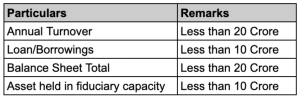
These are ‘all four’ conditions, not ‘any one of four’. If your turnover is well under 20 crore but your borrowings from a bank happen to cross 10 crore, you don’t qualify as a micro entity anymore; you move up to NFRS for SMEs, regardless of how small everything else looks.
The Two-Year Rule
ASB Nepal built in a stability mechanism so entities aren’t flipping between standards every year based on one good or bad year. To become a micro entity, your business has to fall within all four limits for two consecutive years. To stop being one, you need to exceed at least one of those limits for two consecutive years running.
How NAS for MEs Compares to the Other Tiers
It helps to see the three tiers side by side, because a lot of the anxiety around this topic comes from not knowing where you sit relative to the others.
NFRS (full) applies to entities with public accountability like banks, insurance firms, companies whose debt or equity trades in a public market, government business enterprises, and entities that cross fairly high thresholds on borrowings, balance sheet size, employee count, or turnover (broadly, in the hundreds of crores, or 300+ employees).
NFRS for SMEs applies to entities without public accountability that don’t meet the ME definition. Roughly speaking, businesses with turnover, borrowings, or balance sheet size above the micro entity ceilings but below the public-accountability thresholds.
NAS for MEs applies to entities without public accountability that also fall under all four of the micro entity size thresholds described above. This is where most sole proprietorships, small partnerships, and small private limited companies fall.
What’s Actually Inside the Standard
A complete set of financial statements under NAS for MEs typically includes a statement of financial position, a statement of income and expense, a statement of changes in equity, a statement of cash flows, and notes covering accounting policies and other explanatory detail. ICAN has also published model financial statements under NAS for MEs, in both English and Nepali, which are worth downloading if you or your accountant are preparing statements for the first time. They show exactly what a compliant balance sheet and income statement should look like in practice. Click here to download model financial statements under NAS for MEs.
A Quick Worked Example
Say you run a small trading company and your numbers look like this:
- Annual turnover: NRs 12 crore
- Bank borrowings: NRs 3 crore
- Total balance sheet size: NRs 9 crore
- No assets held in fiduciary capacity
Every figure sits below the ceilings, and it’s held that way for two consecutive years. That business qualifies as a micro entity and should be preparing statements under NAS for MEs, not NFRS for SMEs.
Now change one number: bank borrowings jump to NRs 11 crore because you took a loan to expand a warehouse, and it stays above 10 crore for two years running. Turnover and balance sheet size are still within the limit but because you’ve breached even one of the four conditions for two consecutive years, you no longer qualify as a micro entity. You’d move up to NFRS for SMEs from that point.
Where to Get the Official Text
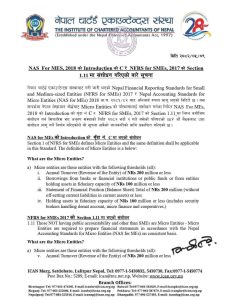
Accounting Standard Board (ASB) Nepal publishes the full standard, and ICAN maintains model financial statements and the effective-date circulars referenced throughout this guide. If you’re preparing statements yourself or briefing a junior accountant, it’s worth pulling the actual PDF of NAS for MEs 2018 alongside the 2082 amendment notice on the definition. The amendment is short, but it’s the document that actually governs which threshold numbers apply right now.
Here is the latest amendment notice:
The Bottom Line
For 2026 reporting, NAS for MEs applies to Nepali entities without public accountability that stay under all four of the revised size thresholds of turnover, borrowings, balance sheet total, and fiduciary assets, each capped at either 20 crore or 10 crore, held consistently across two years. That’s a meaningfully wider net than what used to be, which means a good number of businesses that assumed they belonged under NFRS for SMEs may now qualify for the simpler track.
If you’re not sure where your business lands, the fastest way to find out is to pull your last two years of turnover, borrowings, and balance sheet figures and run them against the four conditions above. It’s a five-minute check that can save a small business a genuinely significant amount in annual accounting costs and for anyone searching “NAS for MEs” trying to figure out where their business fits in Nepal’s reporting framework, that’s really the question this whole guide is meant to answer.