
NFRS Applicability in Nepal is one of the most commonly searched and most misunderstood topics among accountants, business owners, and finance professionals alike. The question seems simple: Does NFRS apply to my organization? But the answer depends on your entity’s size, structure, and level of public accountability.
NFRS Applicability in Nepal: Who Must Follow NFRS?
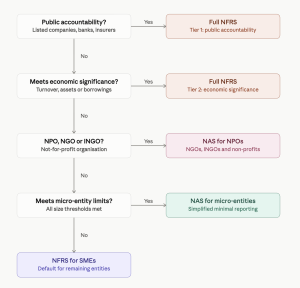
NFRS applicability in Nepal framework is best understood through four tiers:
- Entities with Full Public Accountability: Full NFRS
- Entities with Economic Significance: Full NFRS
- Small and Medium-Sized Entities (SMEs): NFRS for SMEs
- Micro-Entities: NAS for MEs
- Nonprofit Entities: NAS for NPOs
Entities with Public Accountability (Full NFRS Required)
When considering NFRS applicability in Nepal, entities with public accountability, such as listed companies whose debt or equity instruments are traded in a public market, or companies in the process of issuing such instruments, must prepare financial statements in full compliance with NFRS. This category also includes banks, insurance companies, pension funds, mutual funds, and other entities holding assets in a fiduciary capacity as their primary business, as well as government business enterprises (GBEs) and public entities governed by special acts.
In practical terms, full NFRS is mandatory for:
- Commercial banks (including state-owned banks) regulated under the Banks and Financial Institutions Act (BAFIA),which fall strictly under full NFRS applicability in Nepal
- Insurance companies regulated by the Insurance Board of Nepal
- Listed companies on the Nepal Stock Exchange (NEPSE)
- Mutual funds, pension funds, and securities dealers
- Credit unions and investment banks (excluding microfinance institutions and cooperatives that lack economic significance)
- Government Business Enterprises (GBEs) and entities established under special Acts, unless they prepare financial statements under Nepal Public Sector Accounting Standards (NPSAS)
- Listed State Owned Enterprises (SOEs) with a minimum paid-up capital of Rs. 5 billion
- Learn more about GBEs and SOEs.
Entities with Economic Significance (Full NFRS Required)
The criteria determining NFRS applicability in Nepal for economically significant entities include meeting at least one of the following thresholds for two consecutive years:
- Borrowings from banks or financial institutions or public funds or from entities holding assets in a fiduciary capacity of NRs 50 crore or more;
- Statement of Financial Position (Balance Sheet) total (without offsetting current liabilities with current assets) of NRS 1 arba or more;
- Employing more than 300 employees, including workers on average;
- Annual Turnover (Revenue of Entity) of NRS 1 arba or more;
- Holding assets in fiduciary capacity in excess of NRs 50 crore (includes security brokers handling demat accounts, microfinance and cooperatives),
All other corporate bodies and entities not defined as SMEs, or entities with borrowings of at least Rs. 50 crore, automatically trigger full NFRS applicability in Nepal.
Small and Medium-Sized Entities (NFRS for SMEs)
For entities that lack public accountability and are not large enough to meet the economic significance thresholds, a simplified version of the standards applies.
NFRS for SMEs was approved by the Accounting Standards Board Nepal in April 2017, and the mandatory effective date was extended to 1 Shrawan 2080 (17 July 2023), locking in NFRS applicability for Nepal (NFRS for SMEs) from Financial Year 2080-81 (FY 2023-24) onwards.
To determine NFRS applicability in Nepal for an SME, an entity must meet the following criteria:
- Not have public accountability
- Not be a micro-entity
- Prepare general-purpose financial statements for external users
Entities that do not have public accountability must follow NFRS for SMEs if they are SMEs, NAS for Micro-Entities if they qualify as micro-entities, or NAS for NPOs if they are not-for-profit organizations. The correct standard depends on the size and nature of the entity. Not all non-publicly accountable entities default to NFRS for SMEs.
Micro-Entities NAS for Micro-Entities (NAS for MEs)
At the bottom of the hierarchy are micro-entities. The rules for NFRS applicability in Nepal state that an entity must meet all of the following limits to qualify for the lighter NAS for Micro-Entities framework:
- Annual Turnover (Revenue of the Entity) of NRs 20 crore or less
- Borrowings from banks or financial institutions or public funds or from entities holding assets in fiduciary capacity of NRs 10 crore or less
- Statement of Financial Position (Balance Sheet) Total of NRs 20 crore (without off-setting current liabilities against current assets) or less
- Holding assets in fiduciary capacity of NRs 10 crore or less (includes security brokers handling demat account, micro finance and cooperatives)
- Those NOT having public accountability and other than SMEs and other than NPOs are Micro Entities. Micro Entities are required to prepare financial statements in accordance with the Nepal Accounting Standards for Micro Entities (NAS for MEs) consistently
NPOs, NGOs, and INGOs
Not-for-profit organizations follow a separate track entirely. The Nepal Accounting Standard for Not-for-Profit Organizations (NAS for NPOs) is in effect for International NGOs (INGOs) and for other NPOs, including NGOs, not-for-profit associations, and similar entities.
Who Regulates NFRS Compliance?
Compliance doesn’t rest with a single body. Several institutions play crucial roles in enforcing NFRS applicability in Nepal: the Institute of Chartered Accountants of Nepal (ICAN) is the primary body responsible for issuing standards and training professionals; Nepal Rastra Bank (NRB) regulates financial institutions and monitors compliance among banks; the Securities Board of Nepal (SEBON) oversees listed companies and ensures transparency in capital markets; and the Insurance Board of Nepal (IB) enforces standards among insurance companies.
Quick Reference Summary
| Entity Type | Applicable Standard |
|---|---|
| Listed companies, commercial banks, insurance companies, GBEs | Full NFRS |
| Entities with borrowings ≥ NRs 50 crore or balance sheet ≥ NRs 1 arba | Full NFRS |
| Non-publicly accountable entities that are not micro-entities | NFRS for SMEs |
| Very small entities meeting all requirements | NAS for Micro-Entities |
| NGOs, INGOs, NPOs | NAS for NPOs |
Frequently Asked Questions
Does a private limited company in Nepal need to follow NFRS?
It depends on size. If the company has borrowings of NRs 500 million or more, or a balance sheet exceeding NRs 1 billion, full NFRS applies. For smaller private companies, NFRS applicability in Nepal typically defaults to the NFRS for SMEs or the NAS for MEs, depending on specific asset and turnover thresholds.
Are microfinance institutions and cooperatives exempt?
Listed microfinance institutions and cooperatives without economic significance are generally excluded from the full public accountability category.
Is NFRS the same as IFRS?
NFRS is in line with IFRS, the International Financial Reporting Standard used in over 100 countries, including the EU and many G20 nations. Nepal’s version includes some local carve-outs, modifications, and other regulatory overlays.
Conclusion
NFRS applicability in Nepal is not one-size-fits-all. The standard you must follow depends on whether your entity is publicly accountable, its size, and whether it qualifies as an SME or micro-entity. With the mandatory extension of NFRS for SMEs now in effect from FY 2023-24, more Nepalese businesses than ever are within the NFRS ecosystem. If you are unsure where your organization falls, consulting a chartered accountant registered with ICAN is the best first step.